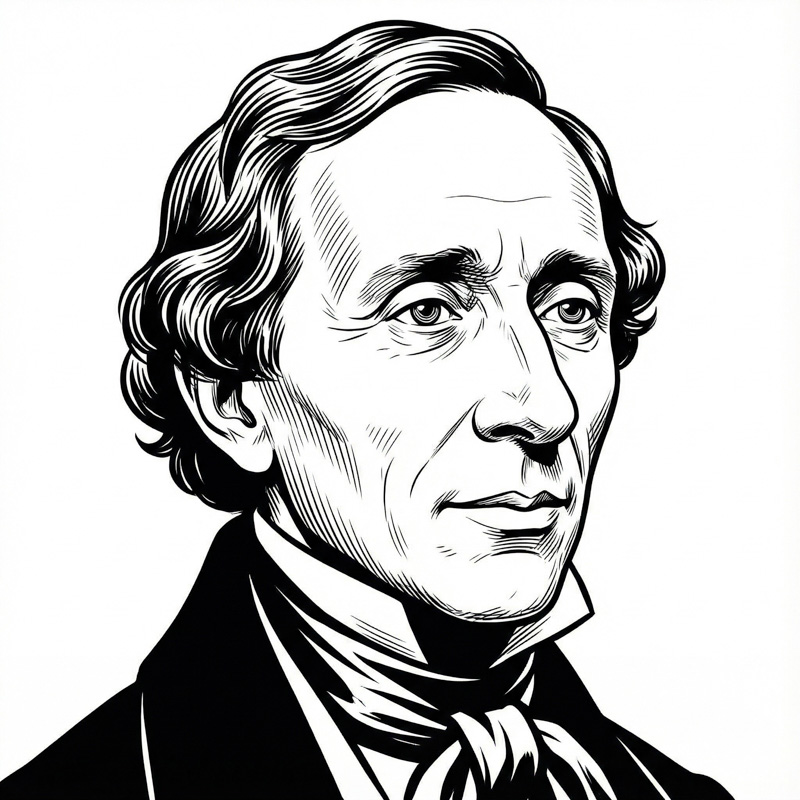
Nobody wanted his fairy tales. In 1835, the gangly, awkward Danish writer published his small pamphlet of fairy tales that critics dismissed as trivial. The stories were too simple, too childish, not literary enough. Hans Christian Andersen was crushed—he'd hoped these tales would be taken seriously as art. One critic suggested he stop writing altogether.
Those dismissed stories? The Little Mermaid. The Emperor's New Clothes. Thumbelina. The Princess and the Pea. They became some of the most influential stories in Western literature, adapted into countless films, ballets, and stage productions. Disney built an empire partially on Andersen's stories. Every modern fairy tale exists in conversation with his work.
But here's what's strange: Andersen wasn't trying to write for children. He was writing stories he needed to tell, stories about outsiders and ugly ducklings and mermaids who sacrifice everything for love. Stories about himself, disguised as fairy tales. He spent his life feeling like he didn't belong—too poor, too weird, too sensitive. So he wrote about characters who transformed, who found their place, who discovered their suffering had meaning.
He died in 1875 famous—but still insecure about his literary standing, still carrying the outsider's feeling that he didn't quite belong. He had no idea his stories would outlive almost everything else written in the 19th century.
Context: The Cobbler's Son Who Wanted to Be Famous
Born in 1805 in Odense, Denmark, Andersen grew up desperately poor. His father was a shoemaker, his mother a washerwoman. He was tall, ungainly, with a large nose and awkward mannerisms. He didn't fit anywhere—not in his social class, not in his body, not in Danish society. He knew from childhood he was meant for something else, though he couldn't say what.
At 14, he moved to Copenhagen alone, determined to become famous. He tried acting—failed. Tried singing—failed. Tried dancing—failed harder. But someone noticed he could write, got him into school on scholarship. He learned, wrote poetry and novels, traveled Europe on small grants, felt perpetually on the outside looking in.
He fell in love repeatedly—with women who didn't love him back, with men he couldn't acknowledge (his sexuality remains debated, but his diaries suggest unrequited feelings for male friends). Every rejection confirmed what he'd always felt: He was the ugly duckling, transformed on the inside but still perceived as strange and unlovable on the outside.
What shaped his stories:
- His poverty and outsider status became his themes
- Unrequited love taught him about longing and sacrifice
- His own feeling of being "wrong" created empathy for misfits
- Traveling through Europe exposed him to folklore traditions
- His need to be loved and recognized drove everything
The Work & The Method: Making Fairy Tales Literary
Before Andersen, fairy tales were folk stories—passed down orally, collected and published by scholars like the Brothers Grimm. Andersen did something different: He wrote fairy tales as original literary works. He took the folk tale form—simple language, magical elements, moral lessons—and made it personal, psychological, devastating.
The Little Mermaid (1837): A mermaid gives up her voice and her tail to become human for a prince who doesn't love her. Every step on land feels like walking on knives. She doesn't get the prince. She dissolves into sea foam. This isn't a folk tale—it's Andersen's autobiography disguised as fantasy. The pain of transformation, the cost of love, the sacrifice that goes unnoticed.
The Ugly Duckling (1843): A bird who doesn't fit in suffers ridicule until he transforms into a swan. It's the most obvious Andersen self-insert. He was the ugly duckling. He spent his life waiting to be recognized as a swan. The tragedy: Even after success, he never felt like one.
The Emperor's New Clothes (1837): Conmen convince an emperor he's wearing magnificent clothes invisible to stupid people. Everyone pretends to see them until a child shouts the truth. Andersen's critique of society, of people's fear of appearing foolish, of the power of group delusion.
His method was to tell stories orally first—to children or friends—then write them down keeping the conversational tone. This was revolutionary. Literary stories were supposed to be elevated, formal. Andersen wrote the way people talked. Critics hated this. Children (and eventually everyone) loved it.
He wrote 156 fairy tales over 40 years. Some happy, many devastating. He couldn't help himself—his sadness leaked into everything. His mermaids don't get happy endings. His tin soldiers burn. His match girl freezes. Beauty comes through suffering, and sometimes suffering just continues.
Impact & Innovation: Creating the Modern Fairy Tale
Before Andersen, fairy tales were folk traditions. After Andersen, they were literature—crafted by authors, psychologically complex, meant to move adults as much as children. Every fairy tale written since exists because Andersen showed the form could carry serious themes while maintaining magic and wonder.
His influence on Disney alone is massive—The Little Mermaid, Frozen (based on The Snow Queen). But beyond direct adaptations, the idea of the fairy tale as authored work, as psychological allegory, as story that works on multiple levels—that's Andersen.
His fingerprints are everywhere:
- Every modern authored fairy tale (Oscar Wilde's fairy tales directly inspired by Andersen)
- Disney's entire aesthetic and approach to fairy tales
- The "ugly duckling" as cultural metaphor
- Stories about transformation and finding where you belong
- The bittersweet fairy tale that doesn't shy from sadness
- How we write about outsiders becoming who they're meant to be
The numbers: 156 fairy tales. Translated into 125+ languages. Adapted into thousands of films, plays, ballets. His statue (The Little Mermaid) is Denmark's most famous landmark. The Hans Christian Andersen Award—administered by the International Board on Books for Young People (IBBY)—became one of the highest international honors in children's literature. But here's the thing: He died in 1875 famous—but still insecure about his literary standing, still carrying the outsider's feeling that he didn't quite belong.
Closing: The Duckling That Never Became a Swan (In His Own Eyes)
Andersen spent his final years famous, invited to dine with kings and artists. Children loved his stories. He should have felt like the swan he'd always known he was inside. But his diaries reveal continued loneliness, continued feeling of not-quite-belonging.
Maybe that's the truest thing about him: The ugly duckling who becomes a swan is wish fulfillment. The little mermaid who suffers for love and gets nothing is reality. Andersen lived both stories—famous but lonely, beloved but never quite loved the way he needed.
"Life itself is the most wonderful fairy tale," he wrote. He spent his life turning his pain into stories that would comfort millions of other outsiders. Kids who didn't fit. Adults who felt like they'd sacrificed everything for recognition that never came. Everyone who ever felt like the wrong shape in the wrong place.
His stories endure because suffering is universal, transformation is possible, and sometimes the ugly duckling realizes he's a swan. Sometimes. Not always. But sometimes is enough to keep hoping.